
Aquatic therapy and land-based physiotherapy are both valuable approaches to rehabilitation. The right choice depends on your diagnosis, symptoms, mobility, goals, confidence, and stage of recovery. For some people, treatment in a warm-water pool makes movement possible when weight-bearing exercise feels painful or intimidating. For others, land-based physiotherapy is essential for rebuilding the strength, balance and movement control needed for everyday life. Often, the most effective programme combines both.
At Keryn Cowell Physiotherapy in Claremont, Cape Town, our physiotherapists provide evidence-informed rehabilitation on land and in water. With a purpose-built aquatherapy pool, a spacious rehabilitation studio and fully wheelchair-accessible facilities, we can tailor treatment to your needs..
Health note: This article is for general information and does not replace an assessment by a qualified physiotherapist. A clinician should determine whether aquatic therapy, land-based therapy or a combination is appropriate for you.
What is aquatic therapy?
Aquatic therapy, also called aquatherapy or hydrotherapy, is physiotherapy performed in a carefully controlled pool. It is not simply swimming or unsupervised exercise. A physiotherapist selects movements, resistance, depth, pace and equipment according to your symptoms and goals.
Water has several properties that can make rehabilitation more comfortable. Buoyancy reduces the amount of body weight carried through the joints, while the water itself provides gentle resistance in multiple directions. Warm water can also help relax tight muscles and make movement feel less painful. These effects may allow a person to practise walking, squatting, reaching or strengthening earlier and with greater confidence than on land.
At Keryn Cowell Physiotherapy, the pool is maintained at approximately 34–35°C, with regulated surrounding air temperature. The pool is salt-water chlorinated and has daily cleaning and water-quality monitoring and testing. Sessions are approximately 45 minutes unless your physiotherapist advises otherwise, and the pool area is supported by accessible changing facilities.
What is land-based physiotherapy?
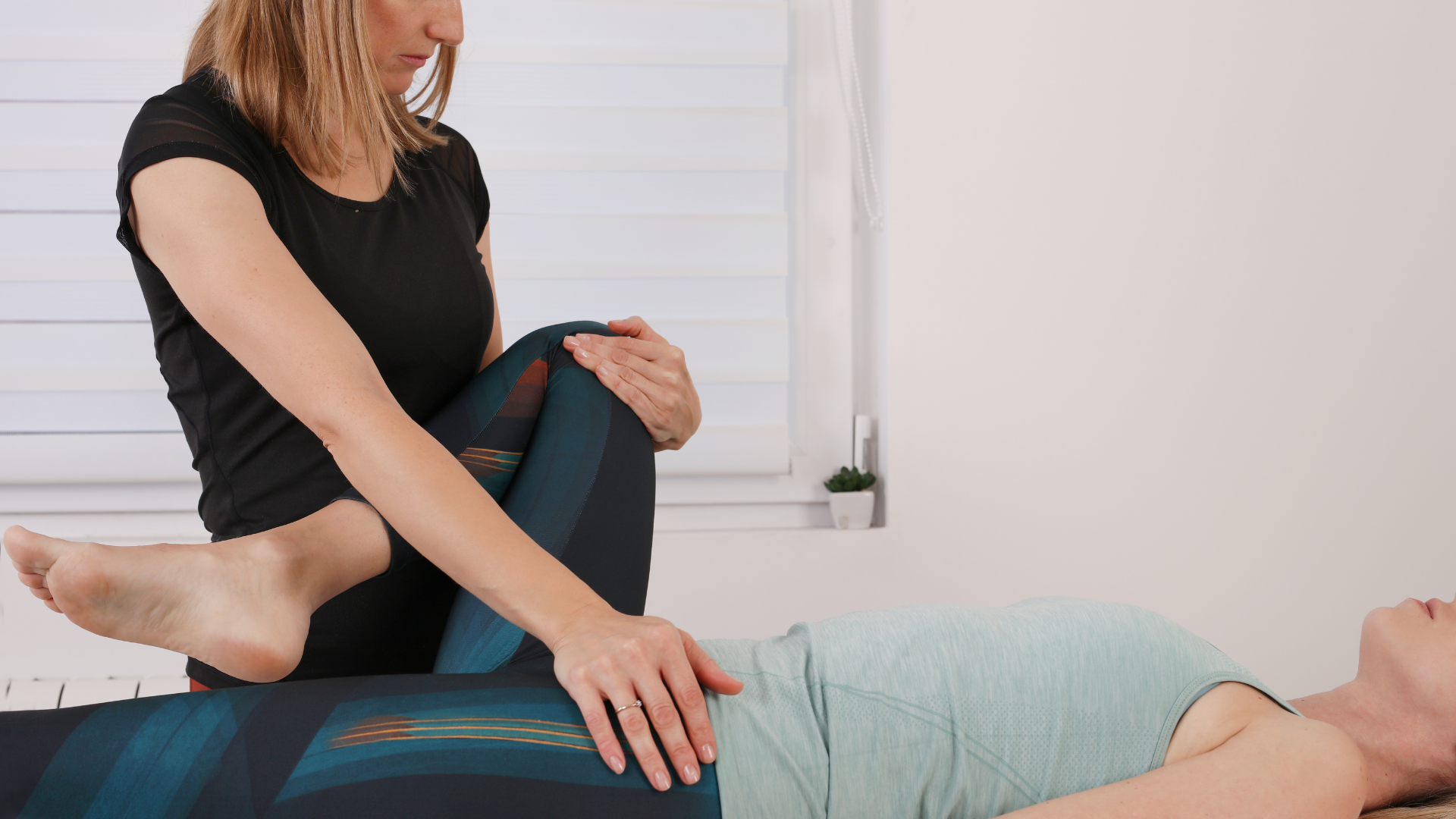
Land-based physiotherapy takes place in a treatment room, rehabilitation studio, gym or everyday environment. It may include education, hands-on treatment where clinically appropriate, mobility work, therapeutic exercise, balance training, gait retraining, breathing exercises and a home programme.
Because the body has to manage its own weight on land, this approach is particularly important for practising real-world tasks. Standing from a chair, climbing stairs, walking on uneven ground, lifting, transferring in and out of bed, or returning to sport all require the body to produce and control force without the support of water.
Land-based physiotherapy can be adapted to almost any level of ability. Exercises may begin in sitting or lying and progress towards supported standing, free-standing movement, resistance work and functional activities. The goal is not to make exercise difficult for its own sake, but to provide the right challenge for your current capacity.
Aquatic therapy versus land-based physiotherapy: the key differences
| Consideration | Aquatic therapy | Land-based physiotherapy |
| Weight-bearing | Buoyancy reduces loading through the body and joints | Requires the body to manage its own weight, with loading adjusted by the therapist |
| Pain and movement | Warmth and support may make movement more comfortable | Enables direct practice of everyday movement and functional loading |
| Resistance | Water provides smooth, adjustable resistance in several directions | Resistance comes from body weight, bands, weights, machines and functional tasks |
| Balance | The therapist can provide a safer environment to practise balance | Develops balance in the conditions encountered in daily life |
| Best suited to | Early rehabilitation, painful joints, reduced mobility, deconditioning and confidence-building | Strength, gait, transfers, functional independence and return to land-based activities |
| Practical requirements | Pool access, suitable swimwear and safe pool entry | Comfortable clothing and an appropriate exercise space |
Neither option is automatically better. They solve different rehabilitation problems, and a thorough assessment is the best way to decide where to begin.
When might aquatherapy be a good option?
Aquatherapy may be considered when pain, weakness, stiffness, fear of falling or reduced weight-bearing capacity makes land exercise difficult. The supportive environment can be especially useful for people recovering from orthopaedic surgery or joint replacement, managing arthritis, living with chronic pain, or rebuilding mobility after an injury. Keryn Cowell Physiotherapy also lists neurological rehabilitation, pulmonary rehabilitation, post-limb-amputation care, older-person rehabilitation and pregnancy exercise among the areas in which its team provides physiotherapy services.
A pool can also offer a psychologically positive starting point. Someone who has avoided movement because it hurts may be able to take longer steps or complete more repetitions in water. That early success can improve confidence and create momentum for later land-based work. Aquatic exercise is also useful when a client needs cardiovascular conditioning but cannot yet tolerate prolonged impact or unsupported exercise.
However, aquatic therapy is not suitable for everyone or every stage of recovery. Your physiotherapist should consider factors such as wound healing, infection, continence, temperature tolerance, cardiovascular or respiratory status, seizure history, skin conditions and your ability to enter and leave the pool safely. These issues do not always rule out aquatic rehabilitation, but they must be discussed before treatment.
When might land-based physiotherapy be the better starting point?
Land-based care may be more appropriate when your primary goals relate directly to walking, standing, lifting, stair climbing, sport, work or household activities. It is also important when you need to build tolerance to load, improve joint control, strengthen specific muscles or practise movements that cannot be reproduced accurately in water.
Some clients prefer land-based treatment because it fits more easily into their routine or because they are uncomfortable in a pool. Others may have medical considerations that require a non-aquatic programme, at least initially. A physiotherapist can still make land exercise gentle, supported and progressive. The starting point could be simple breathing work, range-of-motion exercises, bed mobility or seated strengthening before progressing to more demanding tasks.
Why combining both approaches can be effective
A combined programme often provides the advantages of each environment. Aquatherapy can help you begin moving with less joint loading, practise patterns with reduced fear and improve general conditioning. Land-based physiotherapy can then help you transfer those gains into standing, walking, work, sport and daily activities.
For example, after lower-limb surgery, a therapist might use the pool to practise stepping and joint movement while reducing the load through the operated limb. On land, the same person may work on transfers, walking aids, stair technique and progressive strengthening. The programme can change as pain, strength, balance and confidence improve.
Johns Hopkins describes aquatic physical therapy as commonly progressing towards land-based rehabilitation, with the water serving as a bridge rather than a permanent replacement for functional land exercise. The exact sequence varies. Some clients begin on land, add water-based sessions later, and eventually reduce pool treatment. Others alternate between settings throughout rehabilitation.
How your physiotherapist chooses the right approach
A professional decision should be based on more than the name of your condition. During an assessment, your physiotherapist may consider:
- the nature, severity and irritability of your symptoms;
- your current walking, balance, strength and range of movement;
- recent surgery, injury or medical treatment;
- your cardiovascular and respiratory tolerance;
- your goals at home, work, school, sport or community level;
- your confidence and ability to enter, exit and participate safely in a pool; and
- how you respond to an initial treatment session.
The plan should include measurable goals and regular review. If a movement is too easy, the therapist can increase repetitions, resistance, speed, depth or complexity. If it is too difficult, the therapist can provide more support or select a different exercise. This clinical reasoning is what distinguishes physiotherapy-led aquatic therapy from simply attending a swimming or water-exercise class.
What to expect at Keryn Cowell Physiotherapy
Keryn Cowell Physiotherapy offers both land-based and aquatherapy services from its practice at Quadrant Gardens, 31 Wilderness Road, Claremont, Cape Town. The practice was designed to provide comprehensive rehabilitation, with private treatment rooms, a rehabilitation studio and a purpose-built pool. The entire practice, including the pool, is fully wheelchair accessible.
For an aquatherapy appointment, you should generally bring comfortable swimwear, a towel, suitable non-slip footwear for the pool deck and a water bottle. The practice advises clients to remain hydrated before and after a session and to avoid loose, baggy swimwear that creates unnecessary drag. The receptionistcan provide current information about individual sessions, classes and pool use under physiotherapy guidance.
Most importantly, you do not need to decide alone. A consultation can establish whether aquatherapy, land-based physiotherapy or a blended programme is the safest and most practical route for your recovery.
The right approach is the one that helps you move forward
The choice between aquatic therapy and land-based physiotherapy is not a competition. Water may reduce pain and loading enough to help you start moving; land-based rehabilitation may be essential for turning that progress into everyday independence. In many cases, the best solution is a carefully staged combination.
Keryn Cowell Physiotherapy brings both options together under one clinical team, allowing your programme to evolve as your needs change. If pain, weakness, stiffness, balance concerns or reduced confidence is limiting your movement, contact the practice in Claremont to arrange an assessment and discuss the most suitable path forward.