
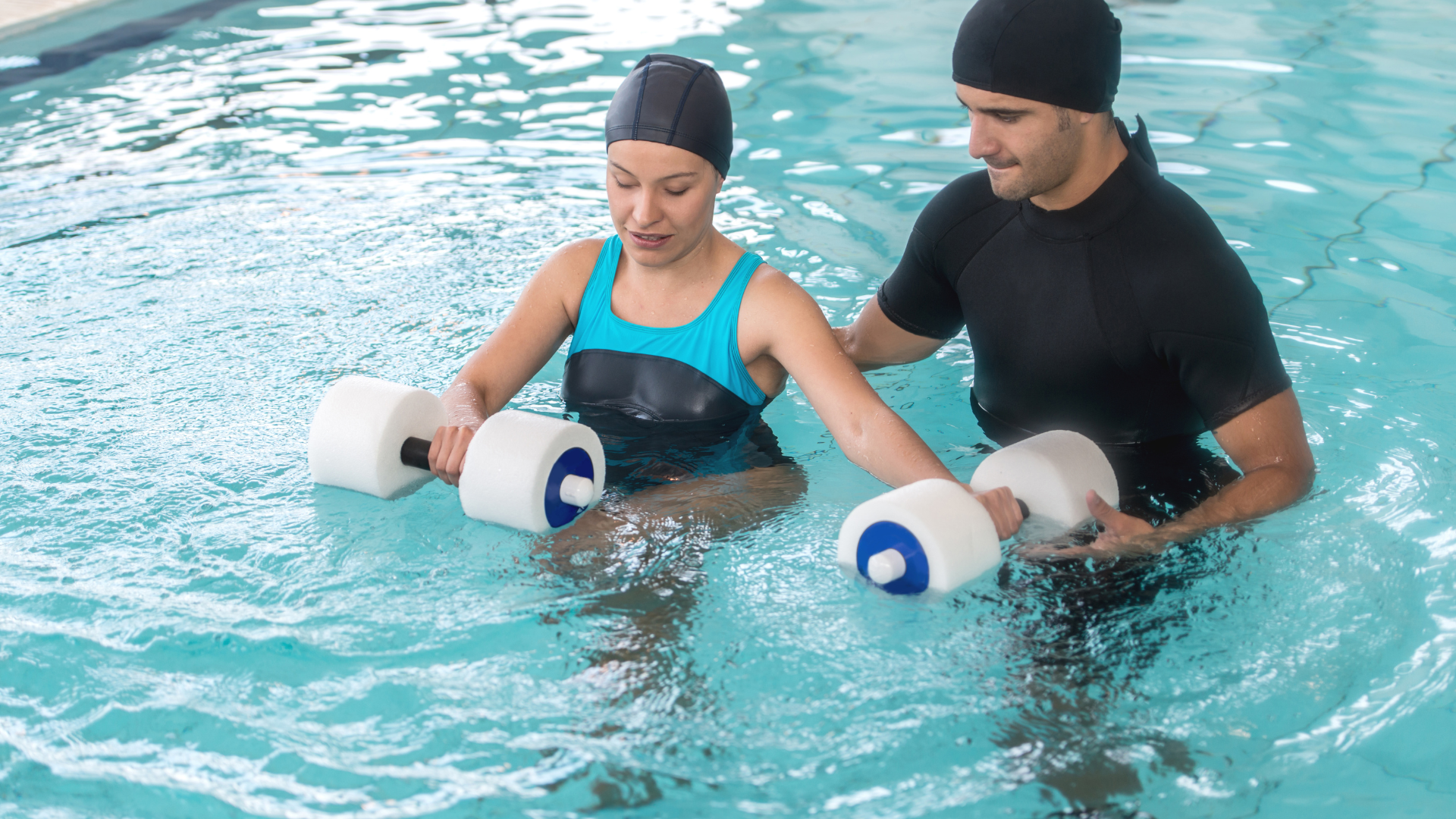
An aquatic therapist does far more than supervise exercise in a pool. In an aquatic physiotherapy session, the therapist assesses how you are moving, considers what you need to achieve, uses the properties of water deliberately and adapts every activity to your response. The aim is to make each session meaningful for your rehabilitation, not simply to keep you active in water.
At Keryn Cowell Physiotherapy, we use aquatic physiotherapy as part of a broader rehabilitation approach. Our purpose-built aquatherapy pool, rehabilitation studio and accessible facilities allow us to choose the setting that best supports your current goals. For some clients, water creates a comfortable place to begin moving. For others, it is one element of a programme that also includes land-based physiotherapy.
An aquatic therapist starts with your assessment and goals
A good aquatic physiotherapy session begins before you enter the pool. Your aquatic therapist reviews the reason for treatment, your current symptoms, your mobility, relevant medical information and the goals that matter in your everyday life. Depending on your needs, this may include looking at how you walk, stand, transfer, balance, breathe or use a particular joint on land.
The next step is deciding whether the water is appropriate for you on that day. This is not a routine box-ticking exercise. Aquatic physiotherapy professional guidance calls for screening, clinical reasoning and an understanding of both the benefits and precautions of the aquatic environment. It also expects the physiotherapist to consider safe entry and exit, your adaptation to the water and your response during treatment.
We use this information to set a clear purpose for the session. Your goal might be to begin weight-bearing after a period of limited movement, improve balance, practise walking with more confidence, build strength, maintain fitness or regain a movement that feels difficult on land. The activity selected should serve that goal.
Water is part of the treatment plan
Water changes the way movement feels and the way it can be progressed. Buoyancy reduces the load through the body and joints, while water provides resistance in every direction. Warm water can make movement feel more comfortable for some people. These properties can create an opportunity to practise movement with less impact than on land.
An aquatic therapist uses those properties with intention. They may choose the water depth to change how much support your body receives. They may use the pool wall, rails, floats or other equipment to give you more stability, or reduce that support as you become more confident. They can change the speed, direction and size of a movement to adjust the challenge without immediately adding external weights.
For example, a person who cannot comfortably practise a full squat on land may begin with a shallower range in water. Someone rebuilding walking confidence may start with supported stepping, then progress to changing direction, managing turbulence or moving through a more demanding pattern. The exercise is not chosen because it looks impressive. It is chosen because it is an appropriate step towards a functional goal.
The therapist guides movement rather than leaving you to exercise alone
Aquatic physiotherapy is not the same as swimming independently or attending a general water-fitness class. During a physiotherapy-led session, the aquatic therapist observes how you move and gives specific feedback. They may guide your posture, show you how to control a movement, adjust your position or change the task when it is either too easy or too demanding.
This hands-on clinical attention is important because the water can make some movements feel easier than they are on land. A movement that appears smooth in the pool may still need work on control, strength, balance or confidence before it transfers to daily life. By watching the quality of the movement as well as the number of repetitions, your therapist can make the exercise more useful and safer for your stage of rehabilitation.
At Keryn Cowell Physiotherapy, we tailor sessions to the individual rather than following a standard pool routine. Our physiotherapists can use water-based work to complement a land-based programme, then adjust the emphasis as your symptoms, strength, mobility and confidence change.
What might an aquatic therapist ask you to do?
The exact content of a session depends on your assessment, but aquatic therapy exercises often fall into several practical categories.
– Moving and walking practice
An aquatic therapist may use walking forwards, backwards or sideways to work on gait, confidence and lower-limb control. Water can provide support while still giving resistance to each step. The therapist may alter your direction, pace, water depth or the amount of hand support to make the activity fit your ability.
– Strength and control work
Water resistance can be used for controlled movements of the arms, legs and trunk. Rather than relying on one fixed weight, the therapist can adjust the demand through speed, surface area, direction and equipment. The focus may be on muscle control, endurance or a specific movement pattern relevant to your rehabilitation.
– Balance and confidence practice
Balance work in water can range from supported weight shifts to more challenging tasks involving reaching, turning or responding to gentle turbulence. The aquatic therapist chooses an activity that allows you to practise without being overwhelmed. As you improve, the task can become more complex while support is reduced gradually.
– Mobility and range-of-motion exercises
Where stiffness or pain makes movement difficult, the warm, supportive setting may help a person begin a comfortable range of movement. The therapist can guide the pace and range, monitor your response and decide whether the movement should be progressed, modified or moved back onto land-based treatment.
These are examples, not a fixed menu. An aquatic therapist does not prescribe the same movements for every diagnosis. Your symptoms, surgery or injury history, functional goals, safety considerations and response to treatment all influence the plan.
Monitoring your response is a central part of the session
An aquatic therapist continually pays attention to how you are tolerating the session. That includes your movement quality, pain response, breathing, fatigue, balance, confidence and ability to follow the exercise safely. If an exercise increases symptoms, causes poor control or uses more energy than expected, the therapist can change it straight away.
This ongoing monitoring is one reason aquatic physiotherapy is not simply “easier exercise”. A supportive pool can make certain movements more accessible, but the treatment still needs the right dose. The physiotherapist may reduce the range, slow the movement, increase support or shorten a set. On another day, they may progress the same activity by increasing repetitions, speed, resistance, complexity or independence.
Professional aquatic physiotherapy standards describe this as a progressive intervention that is adjusted through periodic reassessment. In practical terms, your programme should change because you are changing – not because the calendar says you have reached a particular week.
How the pool session connects to everyday movement
The goal of aquatic therapy is usually not to stay in the pool forever. Your aquatic therapist considers how the progress made in water can support life on land. That might mean moving from supported pool walking to practising with an aid on land, using improved joint movement in a sit-to-stand task, or building enough confidence to restart a broader exercise programme.
Johns Hopkins describes aquatic physical therapy as commonly progressing towards land-based rehabilitation, with the exact route determined by the person’s needs. At Keryn Cowell Physiotherapy, we can integrate aquatic and land-based physiotherapy under one clinical team. This makes it easier to use each environment for what it does best and to adapt the programme as your goals become more functional.
The available research also supports a measured approach. For people with knee or hip osteoarthritis, a Cochrane review found that aquatic exercise may produce small, short-term improvements in pain, disability and quality of life compared with no intervention. That does not mean water therapy is the right choice for every person or condition. It reinforces why an individual assessment and a clearly planned programme matter.
Safety, access and preparation are part of the therapist’s role
Safe aquatic physiotherapy begins with appropriate screening and continues through every stage of the session. Your aquatic therapist considers how you will enter and leave the pool, what support is needed, whether the water environment is suitable and how to respond if your condition changes. They will also explain any pool rules and hygiene requirements relevant to your treatment.
At our Claremont practice, the pool and wider practice are fully wheelchair accessible. Aquatherapy sessions are generally about 45 minutes, unless your physiotherapist advises otherwise. We provide accessible changing facilities, and our team can give you practical information about what to bring and how to prepare for your particular appointment.
Before any aquatic therapy session, share relevant changes in your health, recent procedures, new symptoms or concerns with us. That helps us make a responsible decision about the day’s treatment and, where appropriate, adapt the plan.
The value of an aquatic therapist is clinical reasoning
The most important part of aquatic physiotherapy is not a particular float, exercise or water temperature. It is the thinking behind the session. An aquatic therapist assesses what is limiting you, chooses a safe and purposeful way to work in water, monitors your response and progresses the programme towards the movement that matters to you.
At Keryn Cowell Physiotherapy, we combine evidence-informed aquatic and land-based rehabilitation to support individual recovery goals. If pain, reduced mobility, balance concerns or a difficult return to movement is holding you back, book an assessment with us. We will help you decide whether aquatic physiotherapy should form part of your programme and how it can support your next steps.